Consensus
Multi-indicator consensus engine
20 indicators are evaluated on each timeframe (M5/M15/H1/H4/D1), so notable conditions are highlighted only when alignment is strong.
 Consensus Engine
Consensus Engine is a crypto market analysis dashboard that highlights market conditions using 20 indicators across 5 timeframes, with optional real-time alerts and flow confirmation. It helps traders read alignment faster without acting as trade execution or financial advice. If you want a deeper product walkthrough, learn more about the dashboard.
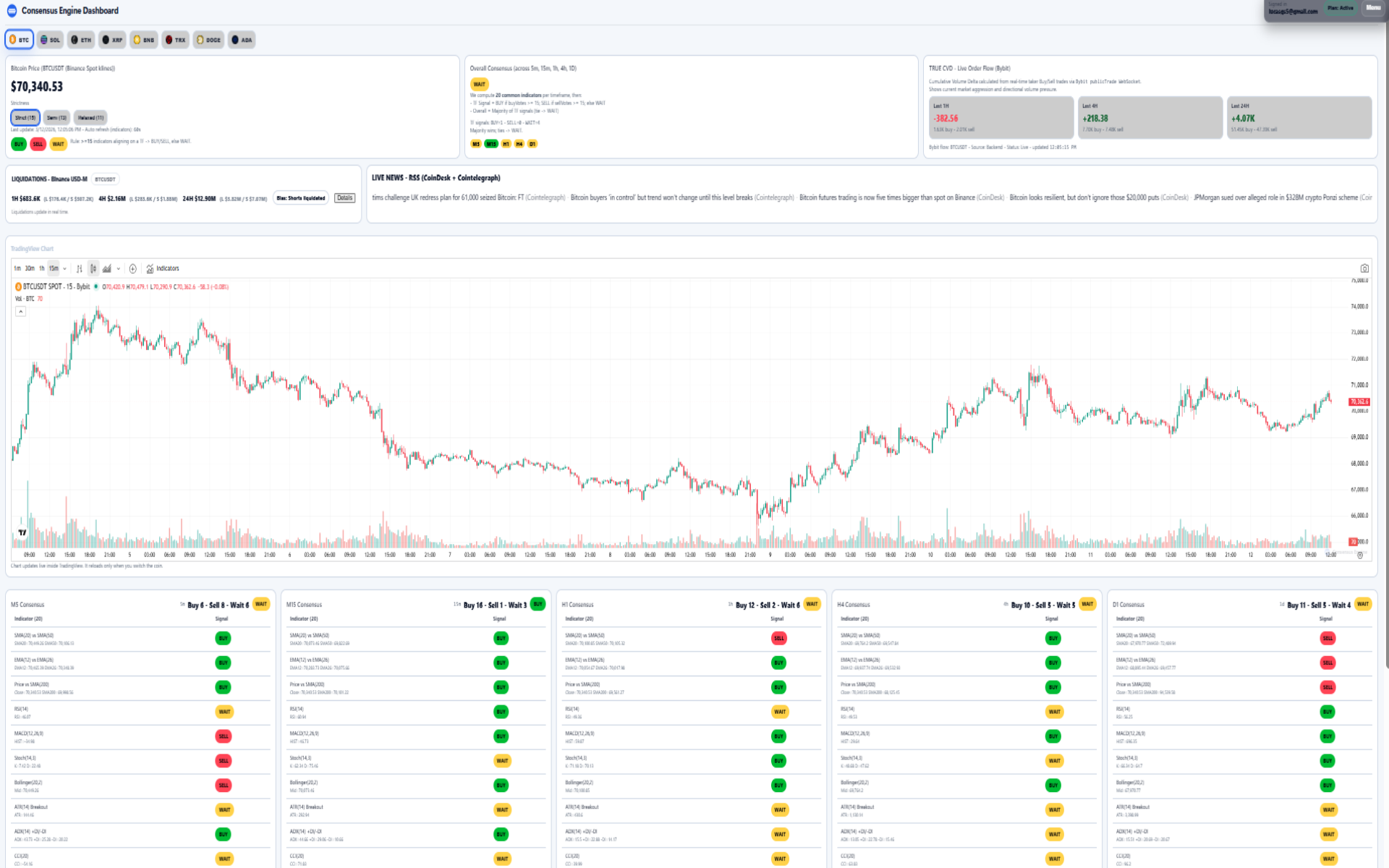
20 indicators across 5 timeframes summarized into one clear view
Who Consensus Engine is for
• Traders who want faster market reads
• Traders using multiple indicators
• Traders looking for clearer confirmation
20 indicators are evaluated on each timeframe (M5/M15/H1/H4/D1), so notable conditions are highlighted only when alignment is strong.
See how market alignment develops across five timeframes, helping you separate stronger trends from short-term noise.
Optional flow validation windows help confirm direction before entries and reduce false momentum breaks.
One screen. No clutter. Built to help traders read market conditions quickly, then decide what to do next.
Start with the main product guide covering market alignment, confirmation, and context in one view.
See how the workflow applies specifically to Bitcoin trading and BTC market structure.
Review how M5 through D1 alignment can be compared in one structured workflow.
Learn how multiple indicator votes are summarized into a clearer market reading.
Explore the alert-focused workflow that combines alignment, confirmation, and broader market context.
If you want a more focused view of how the product fits a specific workflow, explore the Bitcoin indicator dashboard, multi-timeframe trading dashboard, crypto consensus indicator, and trading signal dashboard pages. If you want a broader educational overview first, read the best crypto indicators guide or browse the indicator library.
If you want an educational comparison before looking at the dashboard, these guides explain how commonly paired indicators differ, what each one helps with, and why traders often compare both instead of relying on one reading alone.
Compare fast momentum readings against broader momentum-shift confirmation and see why many traders use both together.
Understand the difference between standard RSI and the more sensitive Stochastic RSI for crypto momentum analysis.
Compare a classic trend tool with a momentum oscillator and see why traders often use both for different jobs.
Compare momentum-shift analysis with volatility context and see why the two tools are often paired rather than substituted.
Compare directional momentum analysis with participation confirmation and see why many traders want both.
Most traders watch too many charts, too many indicators, and too many conflicting readings. Consensus Engine simplifies that process by analyzing multiple indicators across multiple timeframes and summarizing the result into a single dashboard view.
This makes it easier to spot moments when market alignment is actually strong, instead of reacting to isolated indicator readings. You can also explore the crypto indicator dashboard page for a more detailed breakdown.
A dashboard gives traders a faster way to judge market conditions by reducing scattered chart checks into one structured view, making strong alignment easier to spot at a glance.
Multiple indicators must be checked manually across different charts and timeframes, which slows down decision making.
Dashboards consolidate indicator context into a single view so traders can quickly evaluate alignment and ignore weaker conditions.
Consensus Engine analyzes 20 indicators across five timeframes with optional flow confirmation to highlight stronger market conditions.
Consensus Engine helps simplify multi-indicator analysis into one clear view, with optional alerts when predefined conditions align.
Stop checking indicators one by one
Start reading the market in one view
Informational tool only. Not financial advice. No trade execution or portfolio management.