Type
ATR-based volatility channel
 Consensus Engine
Keltner Channels are ATR-based volatility bands around price that help traders frame trend continuation, pullbacks, and possible reversion zones.
ATR-based volatility channel
Trend continuation and volatility framing
Adds a structured volatility framework around price
Channel touches do not automatically mean reversal
Keltner Channels place volatility-based bands around price using ATR-style logic. They help traders judge whether price is moving inside normal conditions or pressing toward channel extremes.
Because the channels are volatility-aware, they can be useful for both continuation context and possible reversion analysis.
Traders use Keltner Channels to frame trend continuation, identify pullbacks inside a channel structure, and judge whether price is stretching toward the outer bands.
They are often combined with ATR, moving averages, or Donchian Channels when traders want more context around volatility, direction, and breakout conditions.
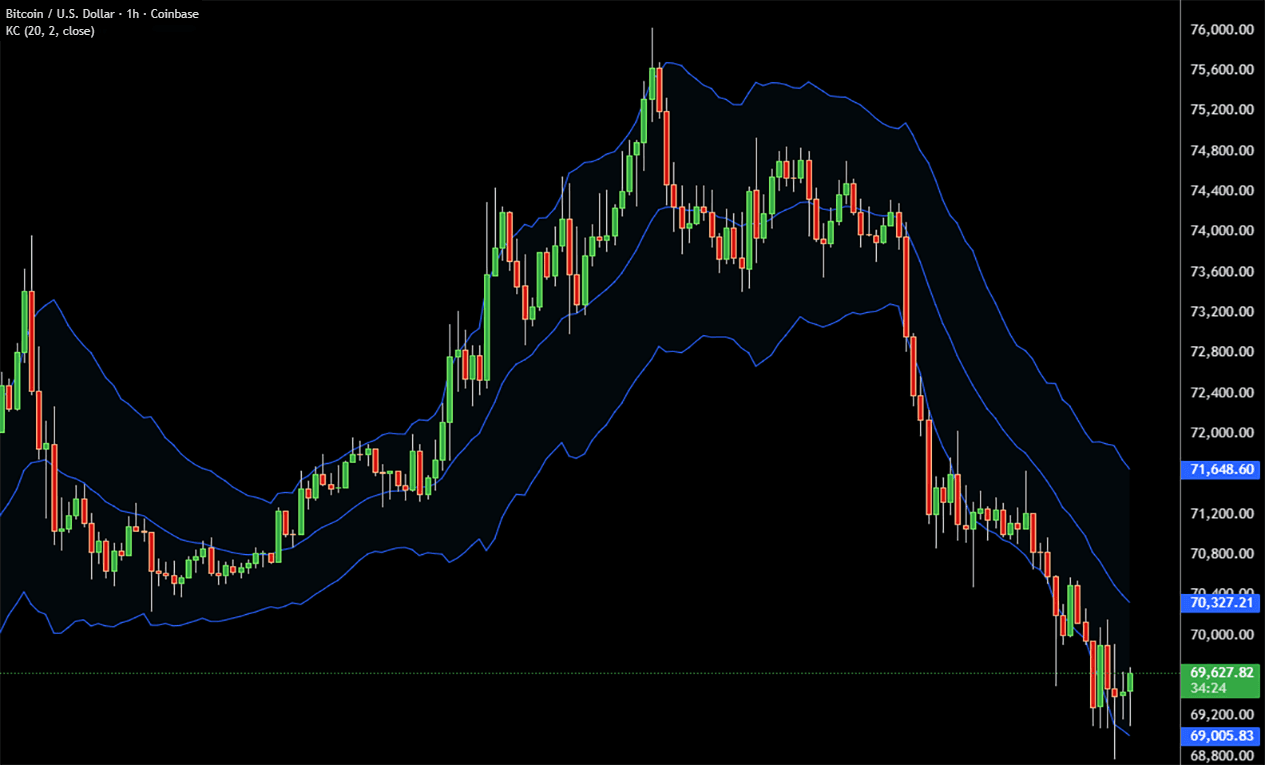
This Bitcoin chart overlays Keltner Channels on price so traders can compare movement with an ATR-based volatility framework.
The Keltner Channel bands help frame where Bitcoin is moving within normal volatility conditions and when price is pressing toward an outer boundary.
Explore closely related indicator guides so momentum, trend, volatility, and participation signals stay connected inside the broader indicator library.
Donchian Channels plot the highest high and lowest low over a lookback period to help traders frame breakout boundaries and range expansion.
Bollinger Bands are volatility bands used to judge expansion, contraction, and relative price position around a moving average.
ATR, or Average True Range, is a volatility indicator used to estimate how much price typically moves over a period.
Moving averages smooth price data and help traders judge broader direction, trend bias, and structure.
Supertrend is an ATR-based trend-following overlay that helps traders read directional bias and trailing trend logic directly on the chart.
Review ATR to understand the volatility logic that supports Keltner Channels.
Compare ATR-based channels with breakout channels based on recent highs and lows.
See how Keltner Channels differ from another popular volatility-band framework.
Review how volatility frameworks work with trend, momentum, and participation tools.
Consensus Engine combines Keltner Channel context with directional, momentum, and participation signals across multiple timeframes.
That keeps volatility bands in perspective instead of treating each channel touch as a standalone event.
Consensus Engine keeps trend, momentum, volatility, and participation tools together instead of scattering them across separate views.
M5 through D1 stay visible together, which helps traders compare short-term movement with broader context.
TRUE CVD adds another confirmation layer when traders want more than price-based indicators alone.
Keltner Channels measure volatility around price using an ATR-based channel structure.
No. Both are channel frameworks, but they use different calculations and can behave differently in changing volatility conditions.
Because volatility channels are more useful when traders can compare them with direction, momentum, and confirmation signals.
Consensus Engine helps traders organize Keltner Channels, related indicators, and multi-timeframe context in one structured dashboard. For the broader authority page, continue to crypto indicators.