Type
Trend-strength indicator
 Consensus Engine
ADX, or Average Directional Index, measures trend strength in crypto markets without telling traders whether the trend is up or down.
Trend-strength indicator
Measuring how strong a trend is
Helps separate stronger trends from weaker conditions
Does not show direction on its own
ADX tracks the strength of a trend rather than its direction. Higher readings suggest the market is trending with more force, while lower readings suggest weaker or more range-bound conditions.
Traders often discuss ADX together with the positive and negative directional index lines, but the core ADX reading itself is mainly used to judge whether a trend has enough strength to matter.
Traders use ADX to avoid treating every breakout or pullback the same. A rising ADX can suggest trend strength is improving, while a flat or falling ADX can suggest the move lacks follow-through.
It is commonly paired with moving averages, Supertrend, or Ichimoku so traders can evaluate both direction and strength instead of relying on ADX alone.
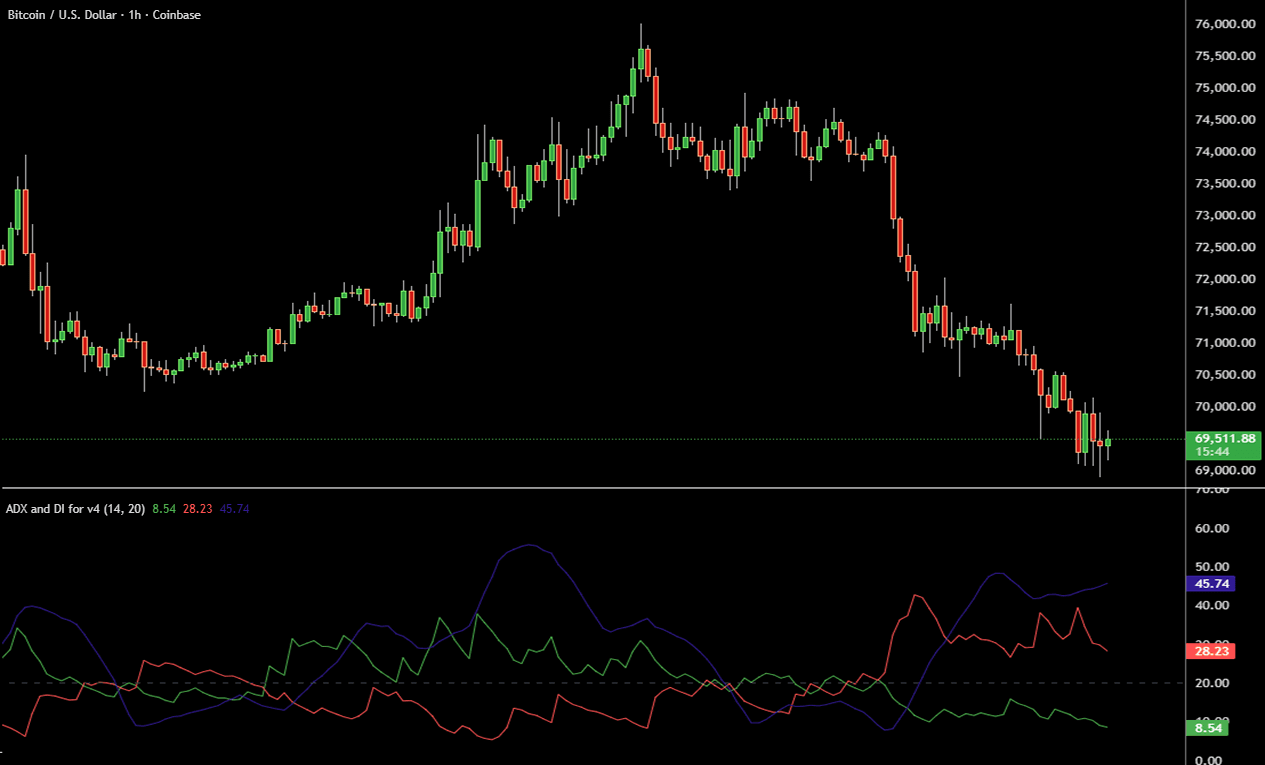
This Bitcoin chart shows price above and ADX below so traders can compare visible direction with the strength of the move.
The ADX panel highlights whether Bitcoin is trending with meaningful strength, while price still has to provide the actual direction.
Explore closely related indicator guides so momentum, trend, volatility, and participation signals stay connected inside the broader indicator library.
Supertrend is an ATR-based trend-following overlay that helps traders read directional bias and trailing trend logic directly on the chart.
Moving averages smooth price data and help traders judge broader direction, trend bias, and structure.
MACD is a trend and momentum indicator used to track directional shifts, momentum transitions, and broader confirmation.
ATR, or Average True Range, is a volatility indicator used to estimate how much price typically moves over a period.
Parabolic SAR is a trend-following indicator that places trailing dots around price to help traders track trend direction and stop-and-reversal style logic.
Pair ADX with moving averages to combine trend direction with trend strength.
See how an ATR-based trend overlay can complement ADX when traders want clearer directional context.
Explore a broader trend framework that can be used alongside ADX strength analysis.
Review how trend, momentum, volatility, and participation indicators work together.
Consensus Engine does not treat ADX as a standalone signal. It combines ADX with directional, momentum, volatility, and participation inputs across multiple timeframes.
That makes it easier to judge whether trend strength is actually aligned with the rest of the market view instead of reading one number in isolation.
Consensus Engine keeps trend, momentum, volatility, and participation tools together instead of scattering them across separate views.
M5 through D1 stay visible together, which helps traders compare short-term movement with broader context.
TRUE CVD adds another confirmation layer when traders want more than price-based indicators alone.
ADX measures the strength of a trend. It does not tell traders whether the market is moving up or down by itself.
Not necessarily. A high ADX points to stronger trend conditions, but price direction still has to be read from price action or other indicators.
Because ADX is most useful when traders can compare trend strength with direction, momentum, and confirmation rather than relying on strength alone.
Consensus Engine helps traders organize ADX, related indicators, and multi-timeframe context in one structured dashboard. For the broader authority page, continue to crypto indicators.