Type
Trend-following overlay
 Consensus Engine
Parabolic SAR is a trend-following indicator that places trailing dots around price to help traders track trend direction and stop-and-reversal style logic.
Trend-following overlay
Trailing trend and stop-reversal logic
Provides a simple visual trailing reference on price
Can flip frequently in sideways conditions
Parabolic SAR tracks trend progression by placing dots above or below price. The placement shifts as trend direction changes, which gives traders a trailing reference on the chart itself.
It is mainly used as a trend-following and stop-management style tool rather than a full market-context indicator.
Traders use Parabolic SAR to trail trends, identify possible reversal points, and manage stop placement as the market moves.
It is often combined with ADX, moving averages, or Supertrend so traders can avoid reading every dot flip as equally important.
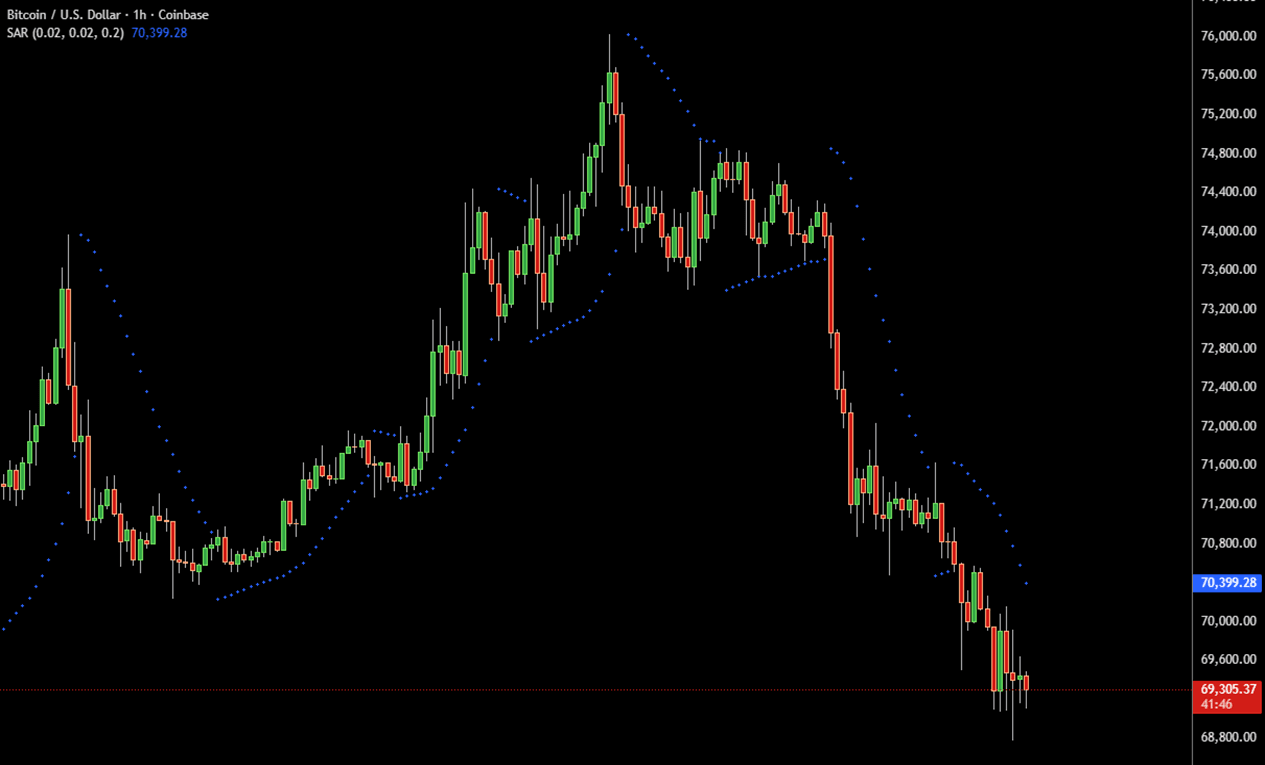
This Bitcoin chart overlays Parabolic SAR dots on price so traders can see how the trailing logic follows the current move.
The Parabolic SAR dots step along with Bitcoin price and can help traders visualize trend-following and stop-reversal style logic.
Explore closely related indicator guides so momentum, trend, volatility, and participation signals stay connected inside the broader indicator library.
Supertrend is an ATR-based trend-following overlay that helps traders read directional bias and trailing trend logic directly on the chart.
ADX, or Average Directional Index, measures trend strength in crypto markets without telling traders whether the trend is up or down.
ATR, or Average True Range, is a volatility indicator used to estimate how much price typically moves over a period.
Moving averages smooth price data and help traders judge broader direction, trend bias, and structure.
Ichimoku is a multi-part trend indicator that helps traders read direction, support and resistance, and broader market context through its cloud structure.
Use ADX with Parabolic SAR to judge whether the current trailing signal has meaningful trend strength behind it.
Compare Parabolic SAR with another trend-following overlay that uses ATR-based logic.
See how Parabolic SAR differs from smoother trend references like moving averages.
Review how trend-following tools fit into a broader indicator process.
Consensus Engine uses Parabolic SAR alongside other directional, momentum, volatility, and participation indicators across multiple timeframes.
That helps traders avoid treating each SAR flip as a standalone signal and instead read it inside broader market context.
Consensus Engine keeps trend, momentum, volatility, and participation tools together instead of scattering them across separate views.
M5 through D1 stay visible together, which helps traders compare short-term movement with broader context.
TRUE CVD adds another confirmation layer when traders want more than price-based indicators alone.
Parabolic SAR tracks trend-following movement with trailing dots that shift as the market direction changes.
Usually not. It can flip frequently in choppy conditions and create noisy signals.
Because it works best when trend-following dots can be checked against trend strength, momentum, and broader market context.
Consensus Engine helps traders organize Parabolic SAR, related indicators, and multi-timeframe context in one structured dashboard. For the broader authority page, continue to crypto indicators.