Type
Momentum and participation oscillator
 Consensus Engine
MFI, or Money Flow Index, is a momentum oscillator that blends price movement with volume-style money flow input to help traders judge strength and extremes.
MFI tracks momentum using both price movement and volume-related money flow input. That gives it a different feel from pure price-only oscillators.
Traders use MFI to judge whether buying or selling pressure is strengthening, weakening, or moving toward stretched conditions.
Traders use MFI for overbought and oversold analysis, divergence, and confirmation when they want momentum readings that also reflect participation.
It is often paired with volume, OBV, or RSI so traders can compare money-flow style momentum with simpler participation and momentum tools.
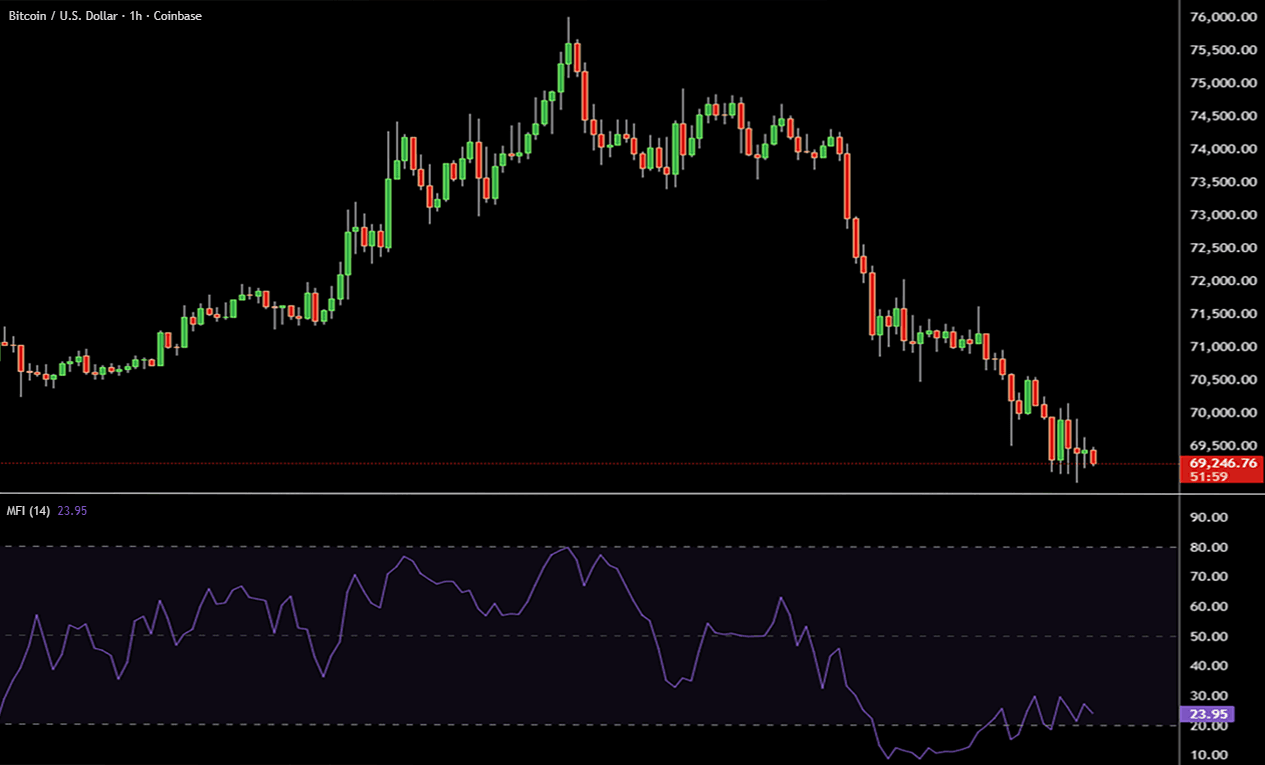
This Bitcoin chart places MFI below price so traders can compare Bitcoin momentum with a money-flow style oscillator.
The MFI panel helps show when Bitcoin momentum and participation-weighted flow are moving toward stronger or more stretched conditions.
Explore closely related indicator guides so momentum, trend, volatility, and participation signals stay connected inside the broader indicator library.
RSI, or Relative Strength Index, is a momentum oscillator traders use to measure momentum and identify overbought or oversold conditions in crypto trading.
Volume measures market activity and is often used to judge whether a move is supported by participation.
OBV, or On-Balance Volume, is a cumulative volume indicator used to compare participation flow with price movement.
Stochastic RSI is a more sensitive oscillator derived from RSI, often used for short-term momentum swings.
VWAP, or Volume Weighted Average Price, tracks the average traded price weighted by volume and is often used as an intraday fair-value reference.
Compare MFI with raw volume when you want to separate activity from momentum-plus-flow analysis.
Use OBV beside MFI to compare cumulative flow confirmation with oscillator-style money-flow analysis.
See how MFI differs from RSI by including participation-style input.
Review how money-flow indicators fit into a broader indicator stack.
Consensus Engine combines MFI with price-based trend, volatility, and participation tools across multiple timeframes instead of asking traders to trust one oscillator alone.
That helps money-flow readings make more sense inside a complete market view.
Consensus Engine keeps trend, momentum, volatility, and participation tools together instead of scattering them across separate views.
M5 through D1 stay visible together, which helps traders compare short-term movement with broader context.
TRUE CVD adds another confirmation layer when traders want more than price-based indicators alone.
MFI measures momentum using both price movement and money-flow style volume input.
MFI is similar to RSI in structure, but it includes participation-style money-flow input rather than relying only on price movement.
Because MFI is more useful when traders can compare its momentum and money-flow signal with trend, volatility, and broader confirmation tools.
Consensus Engine helps traders organize MFI, related indicators, and multi-timeframe context in one structured dashboard. For the broader authority page, continue to crypto indicators.