Type
Momentum oscillator
 Consensus Engine
RSI, or Relative Strength Index, is a momentum oscillator traders use to measure momentum and identify overbought or oversold conditions in crypto trading.
Momentum oscillator
Momentum confirmation
Helps identify overbought and oversold conditions
Can remain extreme in strong trends
RSI uses a 0 to 100 scale to show how strong recent price momentum has been. It helps traders judge whether momentum is strengthening, weakening, or becoming stretched.
Common thresholds are 70 and 30. Readings above 70 are often described as overbought, while readings below 30 are often described as oversold, although those levels are context signals rather than automatic reversal triggers.
Traders use RSI for momentum confirmation by checking whether the oscillator supports the strength or weakness already visible on price.
It is also commonly used for overbought and oversold analysis and for divergence signals, where price and RSI stop moving in the same direction and suggest momentum may be shifting.
Many traders combine RSI with trend tools such as moving averages or MACD so momentum can be read with broader market structure instead of in isolation.
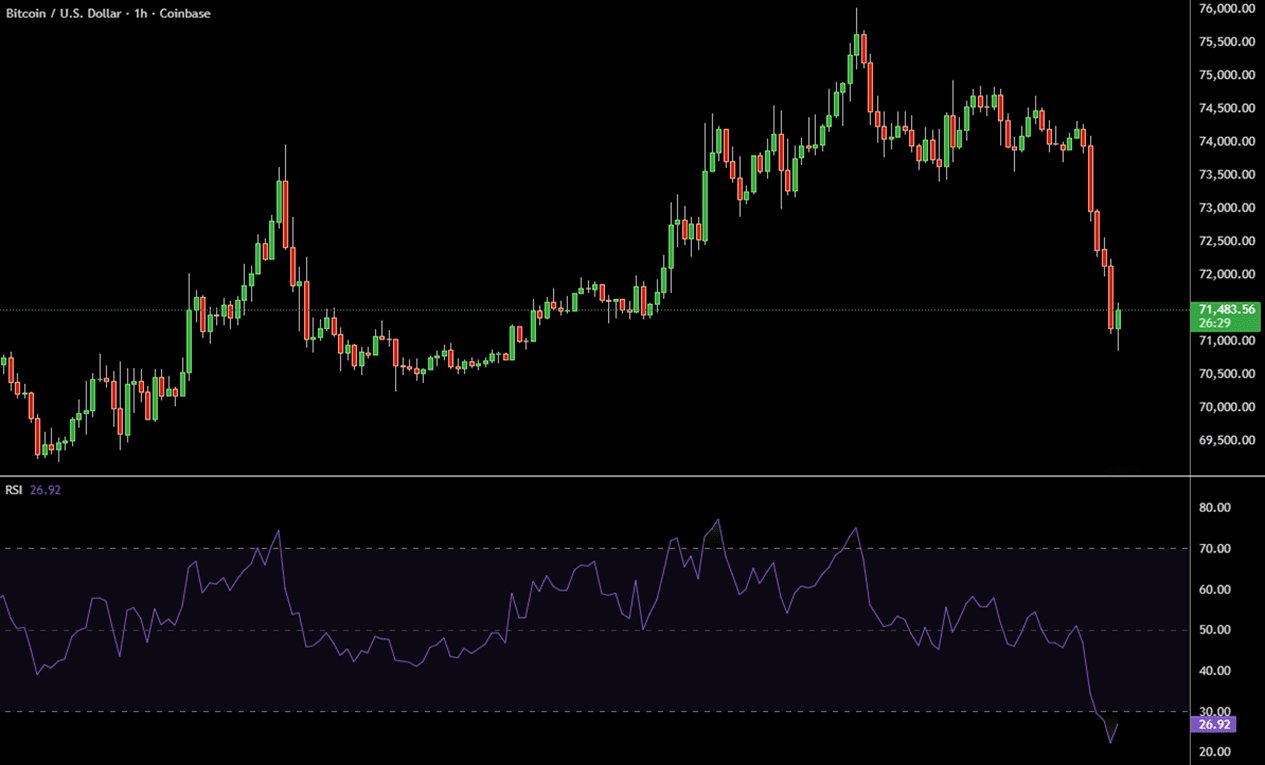
This Bitcoin chart shows price above and the RSI panel below so traders can compare price movement with momentum behavior.
The RSI panel below the Bitcoin chart shows momentum on a 0 to 100 scale and helps traders spot when the market is moving toward oversold conditions.
Explore closely related indicator guides so momentum, trend, volatility, and participation signals stay connected inside the broader indicator library.
MACD is a trend and momentum indicator used to track directional shifts, momentum transitions, and broader confirmation.
Stochastic RSI is a more sensitive oscillator derived from RSI, often used for short-term momentum swings.
MFI, or Money Flow Index, is a momentum oscillator that blends price movement with volume-style money flow input to help traders judge strength and extremes.
Moving averages smooth price data and help traders judge broader direction, trend bias, and structure.
ADX, or Average Directional Index, measures trend strength in crypto markets without telling traders whether the trend is up or down.
Compare RSI with MACD to see the difference between fast momentum context and broader momentum-shift confirmation.
See how standard RSI differs from the more sensitive Stochastic RSI.
Compare momentum context with broader trend framing.
Consensus Engine combines RSI with multiple indicators across several timeframes instead of leaving it isolated on one chart.
That makes it easier to judge whether RSI momentum is aligned with broader trend, volatility, participation, and overall market consensus.
Consensus Engine keeps trend, momentum, volatility, and participation tools together instead of scattering them across separate views.
M5 through D1 stay visible together, which helps traders compare short-term movement with broader context.
TRUE CVD adds another confirmation layer when traders want more than price-based indicators alone.
RSI stands for Relative Strength Index. It is a momentum oscillator traders use to measure the strength of recent price movement on a 0 to 100 scale.
The 70 and 30 levels are common RSI thresholds. Above 70 is often called overbought and below 30 is often called oversold, but those readings still need market context.
Yes. During strong crypto trends RSI can remain elevated or depressed longer than many traders expect, which is why it should be combined with other confirmation tools.
Consensus Engine helps traders organize RSI, related indicators, and multi-timeframe context in one structured dashboard. For the broader authority page, continue to crypto indicators.