Type
Momentum indicator
 Consensus Engine
ROC, or Rate of Change, measures how quickly price is changing over time so traders can track momentum acceleration and deceleration.
Momentum indicator
Tracking momentum acceleration and slowdown
Shows whether price change is speeding up or fading
Reactive readings can become noisy in choppy markets
ROC measures the percentage change in price over a chosen lookback period. That helps traders judge whether momentum is accelerating, slowing down, or turning negative.
It is a straightforward way to compare current momentum with a prior reference point rather than with a moving average or volatility band.
Traders use ROC to confirm accelerating breakouts, weakening trends, and momentum shifts when price starts losing speed.
It is often paired with MACD, RSI, or moving averages so momentum acceleration can be checked against broader direction and structure.
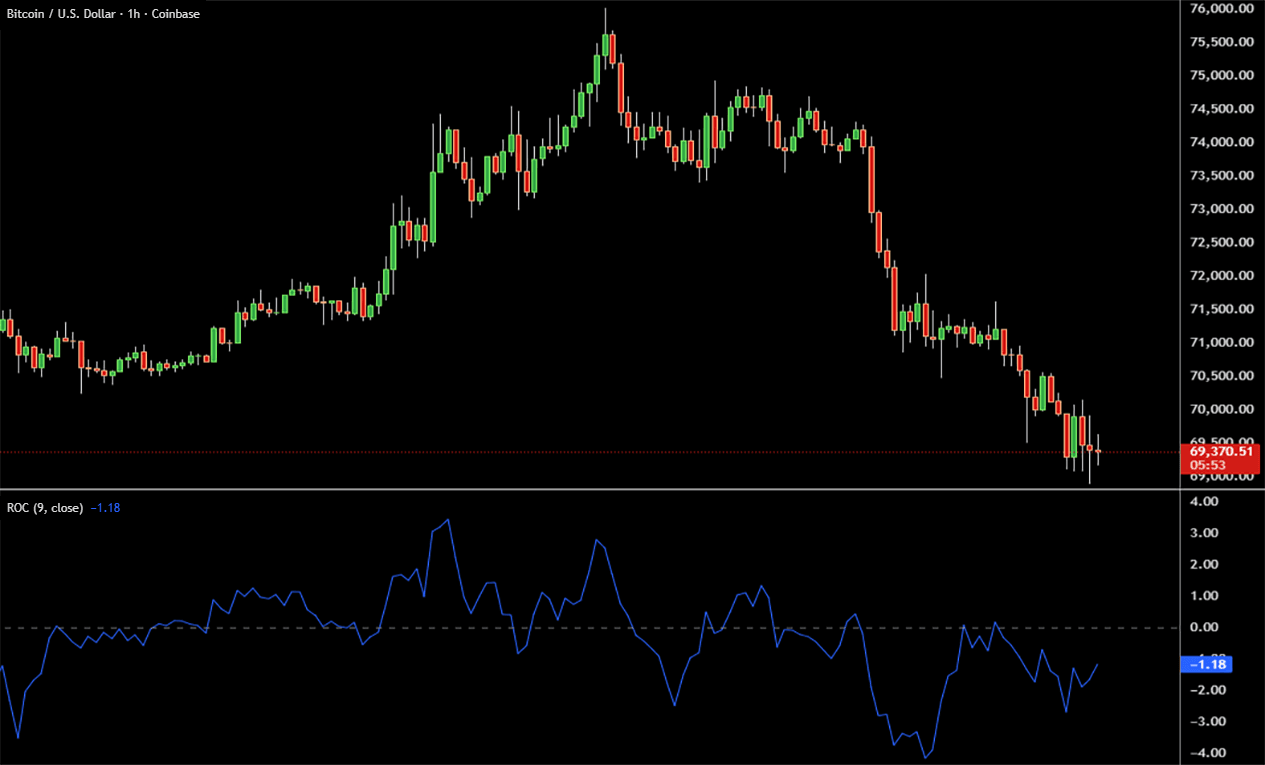
This Bitcoin chart shows ROC below price so traders can compare visible price movement with the speed of that movement.
The ROC panel helps show when Bitcoin momentum is speeding up, slowing down, or crossing back toward neutral conditions.
Explore closely related indicator guides so momentum, trend, volatility, and participation signals stay connected inside the broader indicator library.
CCI, or Commodity Channel Index, measures how far price has moved away from its recent average to help traders judge momentum and potential extremes.
RSI, or Relative Strength Index, is a momentum oscillator traders use to measure momentum and identify overbought or oversold conditions in crypto trading.
MACD is a trend and momentum indicator used to track directional shifts, momentum transitions, and broader confirmation.
Stochastic RSI is a more sensitive oscillator derived from RSI, often used for short-term momentum swings.
MFI, or Money Flow Index, is a momentum oscillator that blends price movement with volume-style money flow input to help traders judge strength and extremes.
Compare ROC with MACD to see the difference between raw momentum change and moving-average-based momentum analysis.
Use RSI beside ROC when you want another momentum read focused on overbought and oversold conditions.
See how momentum indicators like ROC fit into a broader multi-category workflow.
Review how ROC-style momentum signals become easier to read in market context.
Consensus Engine keeps ROC in a broader signal stack so momentum acceleration can be checked against trend, volatility, and participation across multiple timeframes.
That reduces the chance of reacting to one fast momentum reading without the rest of the market agreeing.
Consensus Engine keeps trend, momentum, volatility, and participation tools together instead of scattering them across separate views.
M5 through D1 stay visible together, which helps traders compare short-term movement with broader context.
TRUE CVD adds another confirmation layer when traders want more than price-based indicators alone.
ROC measures how much price has changed over a set period, which helps traders track momentum acceleration and deceleration.
No. Both are momentum tools, but ROC focuses on rate of change while RSI focuses on relative momentum strength within a bounded scale.
Because ROC is more useful when traders can compare momentum speed with trend direction, volatility, and confirmation signals.
Consensus Engine helps traders organize ROC, related indicators, and multi-timeframe context in one structured dashboard. For the broader authority page, continue to crypto indicators.